










































It’s another long day in math class. The teacher lectures on coefficients, and you slump in your chair, counting the minutes until the bell rings. Without thinking, you sneak a peek at your phone and before you know it, your locked in: TikTok has taken priority over algebra.
Losing focus to our devices happens daily, and we all, at some point or another, fall victim to the endless doom scroll. In schools across the country, however, we are seeing a stark drop in test scores and skills, according to the Nation’s Report Card for 2024, and many are pointing to the problem of cell phones in schools.
But there is a simple way to counteract the problem.
This fall, many schools across the nation decided to enforce a complete ban, a “cell-phone free campus,” a move that is clearly working, and Saint Stephen’s needs to follow suit. The “phone-free classroom” policy now in place just isn’t cutting it.
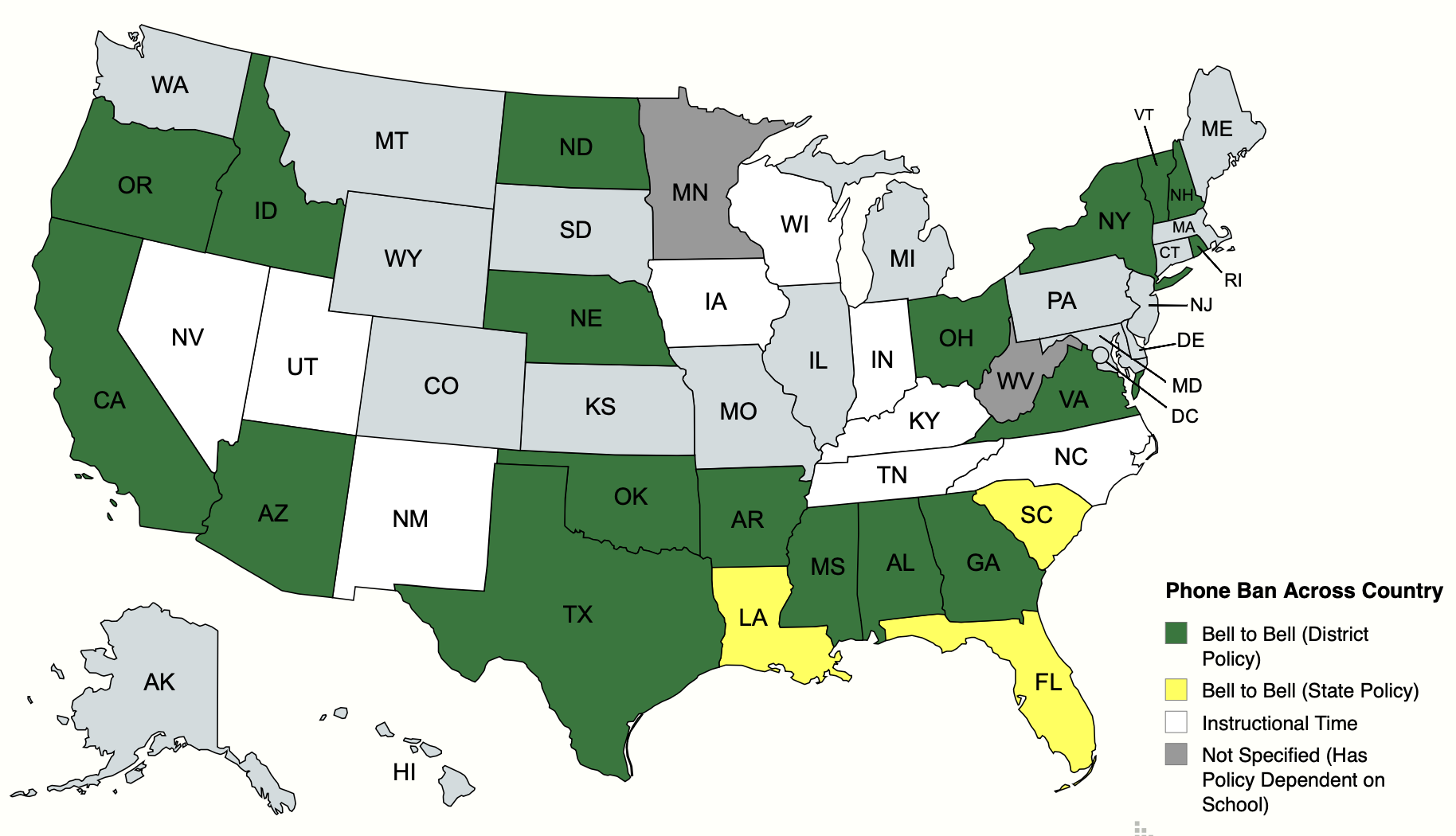
Schools like Cardinal Mooney in Sarasota, Fern Creek High School in Louisville, Kentucky, and Evanston Township High School in Evanston, Illinois, have implemented “phone-free” policies for the whole school day, and what these schools and others across the nation have in common are clear positive outcomes: they report higher in-class engagement, fewer disciplinary issues, and enhanced sociability.
Fern Creek surveyed its students shortly after the policy change, and according to its administration, 44% of students reported feeling more engaged in class and learning more than they did last year.
The administration said, also, that students are spending more time connecting during lunch, and that the library had more books checked out in the first two weeks of school than in the entire previous year.
Ballard High School, also in Kentucky, saw very similar results when it went phone-free: 67 percent more books were taken out in August of this year compared to the previous year, and the staff related that there is a noticeable change in students connecting with one another.
Brody Redmon is a junior at Cardinal Mooney, who also made the step this year to go phone-free.
Redmon admits that although he “doesn’t like them [the pouches] too much,” they “make you focus on your work way more.”
The main argument for keeping phones on campus is usually about safety: students want their phones for emergencies. But at Saint Stephen’s, families are notified immediately of any security breach, and they’re updated by the administration every 30 minutes or so via email. We also have a highly trained officer on campus at all times.
As a result, we believe the benefits of not having phones outweigh the fear of a security risk.
Schools across the country have made the switch to phone-free campuses, and now that a few months have passed, the evidence is clear: phone-free campuses work. And they work well.
We believe that cellphones are distracting and prevent the kind of real social interaction that would be possible without them. By banning phones from the schools, we eliminate a device that keeps us from learning and connecting. It’s time to follow the evidence and make the change.